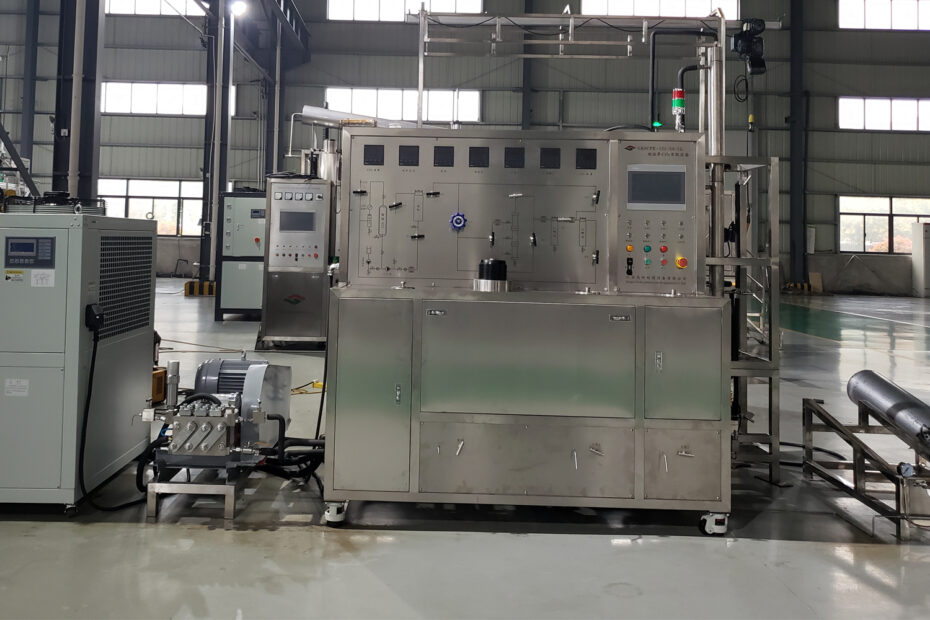
As green chemistry and sustainable development gain momentum, traditional organic solvent extraction faces serious challenges due to environmental pollution and solvent residue risks.
Against this backdrop, supercritical fluid extraction (SFE) has emerged as an advanced technology because of its unique physicochemical properties.
Among various supercritical fluids, supercritical carbon dioxide (SC-CO₂) stands out as a preferred extraction medium.SC-CO₂ offers non-toxicity, non-flammability, low cost, easy availability, and simple separation from products.
Therefore, industry widely recognizes SC-CO₂ extraction as an effective method for producing high-quality natural products, fine chemicals, and pharmaceutical intermediates.
Supercritical CO2 refers to a state where carbon dioxide is subjected to specific temperature and pressure conditions, surpassing its critical point. In this state, CO2 behaves both as a liquid and a gas, showcasing unique properties ideal for extraction purposes.
Supercritical Fluid Extraction Proecss :Technical Advantages and Basic Principles
SC-CO₂ extraction attracts strong interest due to its fast mass transfer, strong penetration ability, high extraction efficiency, and low operating temperature.
Mass Transfer And Penetration Advantages
- Under supercritical conditions, CO₂ combines gas-like diffusivity with liquid-like solvating power.
- As a result, solute molecules rapidly diffuse into the fluid and dissolve efficiently, which significantly shortens extraction time.
Low-Temperature Operation
- SC-CO₂ has a critical temperature of only 31.1 °C, allowing extraction near ambient temperature.
- Consequently, the process effectively protects heat-sensitive compounds such as vitamins, alkaloids, and essential oils from thermal degradation.
Green and Environmentally Friendly
- CO₂ remains non-toxic, odorless, and residue-free throughout the process.
- Moreover, simple depressurization enables complete separation of CO₂ from products, eliminating solvent pollution and safety hazards.
Process Description
The main extraction process of supercritical CO2 fluid consists of extraction and separation. In the extraction equipment, at a specific temperature and pressure, the raw materials are brought into contact with the supercritical fluid. When the dynamic balance of the material components between gas and liquid is reached, the temperature and pressure are adjusted to separate the extraction product from the supercritical fluid to complete the supercritical process. The entire process of extraction.
- The extraction process involves continuous establishment and disruption of dynamic equilibrium.
- First, raw materials contact supercritical CO₂ inside the extractor under controlled temperature and pressure.Once the system reaches phase equilibrium, the solute-rich CO₂ flows into the separator.
- Subsequently, parameter adjustment, typically pressure reduction, breaks the solubility balance.As a result, extracted compounds precipitate, completing the extraction cycle.
The supercritical CO2 extraction device can be used to extract materials (solid and liquid) at high pressure and suitable temperature under separator replacement conditions, so that the soluble materials can decompose the target products during the extraction and separation process.
Supercritical CO₂ Fluid Extraction: Unveiling the Technology
Supercritical fluid extraction involves the use of carbon dioxide (CO₂) at a temperature and pressure above its critical point. In this supercritical state, CO₂ exhibits both gas and liquid properties, making it an exceptional solvent for extracting compounds from various matrices.
The Supercritical State of CO₂
At temperatures above 31.1°C and pressures exceeding 7.39MPa , CO₂ transitions into a supercritical state. In this state, it possesses a higher density and solvating power, enabling it to penetrate materials with the efficiency of a liquid while maintaining the diffusivity of a gas.
Supercritical CO₂ is a commonly used solvent for supercritical fluid extraction. Its critical temperature (31.06°C) and critical pressure (7.39MPa) are low. On the one hand, it can realize supercritical extraction operations near room temperature, reducing energy consumption. On the other hand, it also reduces the requirements for equipment. At the same time, it also It can ensure that heat-sensitive substances will not be thermally decomposed during the extraction process.
The solvency of supercritical fluids is roughly proportional to density. Near the critical point of carbon dioxide, small changes in temperature and pressure can cause large changes in fluid density, thereby causing significant changes in the solubility of supercritical carbon dioxide fluid. Therefore, by changing the temperature and pressure of the initial critical carbon dioxide, substances can be extracted selectively.
The practical application of supercritical CO₂ fluid extraction in production is achieved through safe and reliable extraction devices.
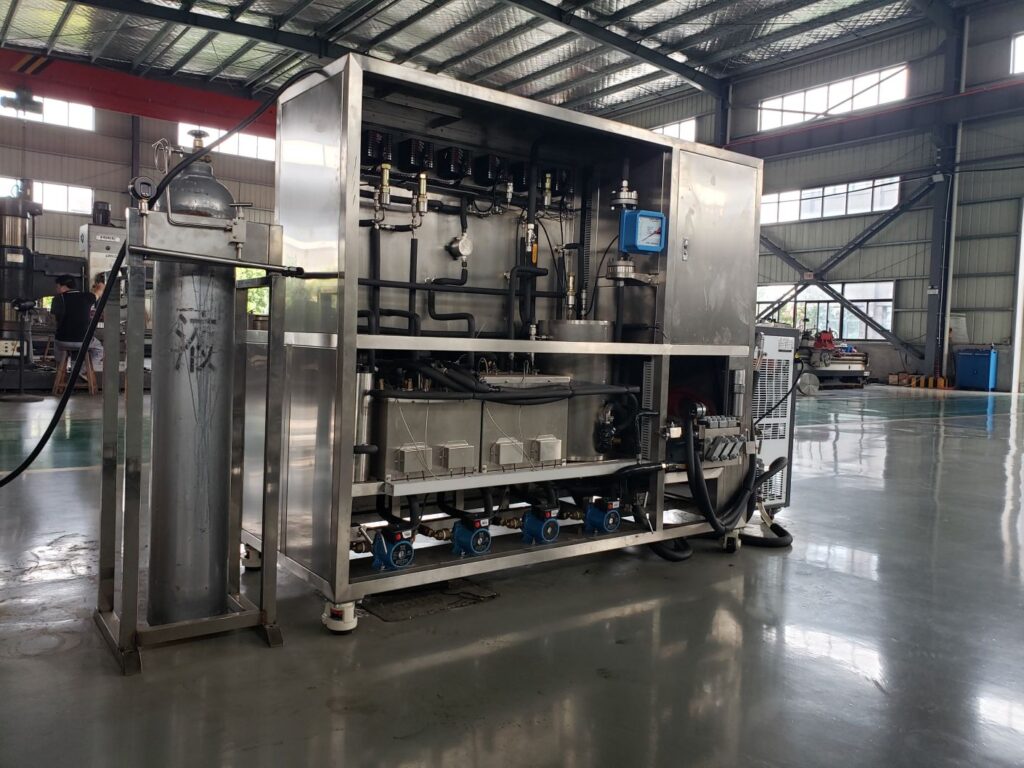
Configuration of SC-CO₂ Extraction Units
A complete SC-CO₂ extraction unit forms the foundation of industrial-scale production.Although configurations vary by product and application, most systems include five core modules.
Refrigeration System
- The refrigeration system cools liquid CO₂ to a suitable storage temperature and ensures stable feed supply.
Pressurization System
- The pressurization system serves as the core of the unit and typically uses high-pressure plunger pumps.
- It compresses liquid CO₂ to supercritical pressures, usually ranging from 8 to 35 MPa or higher.
Extraction System
- The extraction vessel provides the primary contact zone for raw materials and supercritical CO₂.
- Inside the vessel, solid or liquid feedstock mixes thoroughly with CO₂, enabling efficient solute dissolution.
Separation System
- The separation system reduces CO₂ solubility by adjusting pressure or temperature.
- Accordingly, target compounds precipitate from the fluid through isothermal depressurization, isobaric cooling, or adsorption separation.
Recovery and Recycling System
- After separation, the system condenses and recycles CO₂ back to the high-pressure pump.
- This closed-loop operation lowers operating costs and reinforces the system’s environmental benefits.
Conclusion
Supercritical CO₂ extraction is reshaping traditional chemical and food extraction industries through its green, efficient, and mild characteristics.
With continued advances in materials science, automation, and mechanical design, SC-CO₂ extraction will play an increasingly vital role in green chemistry and high-end manufacturing.